Where Stories Come From
3/5/2026
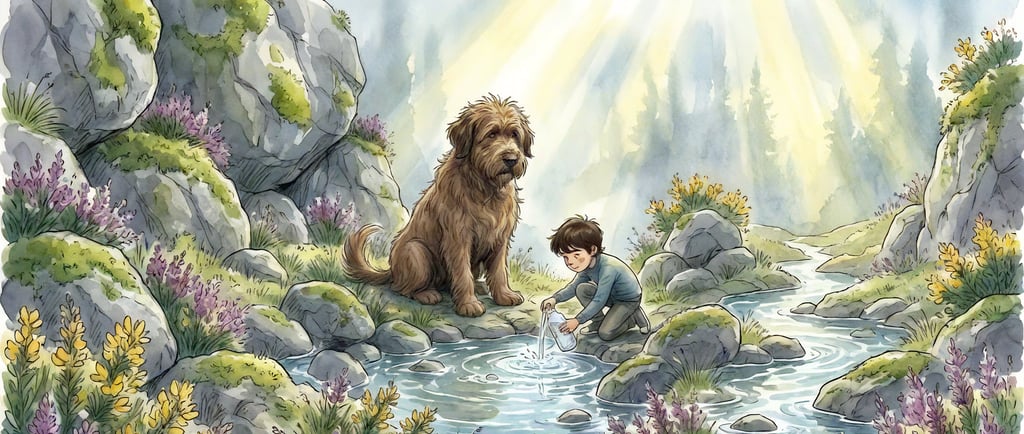
Before I tell you about The Brown Dog of the Green Glen, I want to tell you where it came from. Because it didn't start with me.
It started, as so many good things do, with a very old book and a very rainy afternoon. As is Scotland’s wont…
I came across a collection of Scottish folk tales, the kind of volume that sits quietly on shelves for decades waiting to be properly read. The library stamp was from 1989. Retro. Inside were many stories but one stuck with me. A boy, a quest, a loyal dog, and the kind of adventure that feels like it was always meant to be told. The moment I read it, something clicked. This was exactly the kind of story I'd been looking for.
What struck me most was how relevant it still felt. Centuries old, and yet completely immediate. We’ve all got our own memories of having to do scary things but doing so knowing they’re the right thing to do.
Anyway, it shouldn't surprise anyone who knows Scotland's storytelling tradition. This is a country that produced Burns, a farmer's son who never crossed an ocean in his life, yet whose words have circled the globe more times than anyone could count. Every January, in countries Burns never visited and couldn't have imagined, people sit down together and recite his poetry. That's what a great story does. It doesn't stay where you put it.
Walter Scott understood this too. He spent years collecting and preserving the ballads and folk tales of the Scottish Borders, convinced that if nobody wrote them down they would simply disappear. He was right to worry. And even more right to act.
But Scotland is far from alone in this. Across the water in Ireland, storytellers travelled between villages carrying myths, legends, and local histories in their heads, the way other people might carry tools. They were essential. They were the keepers of everything a community needed to know about itself.
Go further north and you find the same thing. In Iceland and Norway, the long winters created something remarkable. When it's dark by mid-afternoon and the cold keeps you indoors for months at a time, in a world without television (I know… ) or electricity or any of the things we reach for without thinking, stories become the primary form of entertainment, education, and connection. The Norse sagas didn't emerge from nowhere. They emerged from necessity. From people gathered around fires with time on their hands and a deep human need to make sense of the world.
And that need goes back further than any of us. In ancient Egypt, stories weren't just for passing the time. They were how morality was taught, how religious beliefs were defined, how pharaohs established their legitimacy. A story wasn't a luxury. It was cultural infrastructure.
Which makes me think that perhaps Netflix is just the latest version of something that has always been with us. The technology changes. The storytellers change. But the need never does.
When I modernised The Brown Dog of the Green Glen for my own children, I wasn't trying to improve on something old. I was trying to make sure it survived into the hands of the next generation of readers. That felt like an important thing to do.
I hope they feel it the way I did on that rainy afternoon. Something old, something alive, and something completely theirs.
More soon.
Ross
Contact Us
Reach out for questions, comments, school visits and press inquiries.
hello@browndogbook.com
© 2026. All rights reserved.